Portugal Stadiums Architecture History Where to Stay FAQ Newsletter
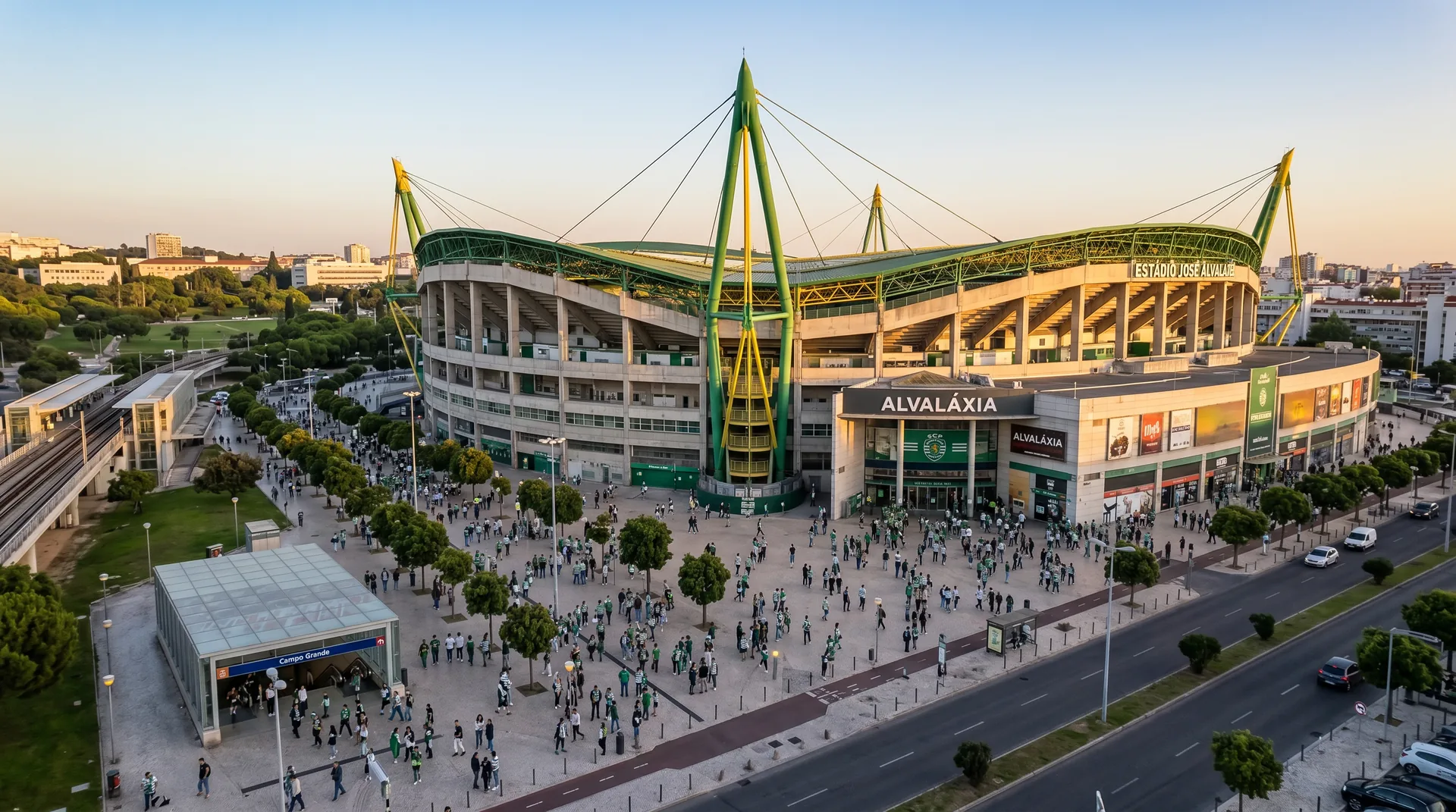
Estadio Jose Alvalade's green stands, Sporting CP's home in Lisbon for the 2030 FIFA World Cup
Portugal · World Cup 2030 Stadium Guide

Estadio Jose Alvalade

Sporting CP's home is mid-transformation: the moat separating fans from the pitch since 2003 is being filled in, new lower-tier seating added, and the whole project handed to the Spanish architects behind Qatar's landmark Stadium 974.

50,095Capacity
+2,000Seats Being Added
Fenwick IribarrenRenovation Architect
2003Opened
📍Campo Grande, Lisbon
Home: Sporting CP
🏗Status: "Alvalade 2.0" Renovation Under Way
UEFA Five-Star Stadium
🎭2025 Women's Champions League Final host
Architecture Alvalade 2.0 History World Cup Role Getting There Where to Stay All Stadiums FAQ

Architecture & Design

From Colourful Mosaic to Green and White

Estadio Jose Alvalade opened on 6 August 2003, designed by Portuguese architect Tomas Taveira as the centrepiece of Alvalade XXI, a wider complex including a shopping mall, health club, museum, sports pavilion, clinic and office building. Construction cost EUR184 million, some EUR80 million over the original budget, with EUR17.9 million supported by the Portuguese state.

The stadium's seats were originally arranged in a distinctive, random-looking mosaic of mixed colours. Between 2021 and 2022, Sporting CP gradually replaced every seat with green, the club's primary colour, also repainting the roof support towers and access stairways, which had been bright yellow, to match.

Alvalade was projected to hold 42,000 spectators when planned, but ultimately opened with a capacity of 50,095, acoustically engineered specifically to double as a major concert venue, a role it filled for years as the "Cathedral of Rock" before the club ended music use in 2009 due to pitch damage.

Planning a trip around this stadium? See the full Lisbon guide →

Alvalade 2.0

Filling In the Moat

Sporting CP has handed the stadium's biggest transformation since 2003 to Fenwick Iribarren Architects, the Madrid-based firm behind Qatar's world-first dismantlable Stadium 974, RCDE Stadium in Barcelona, and Serbia's upcoming National Stadium of Belgrade. Work began at the end of April 2025 and is continuing through the 2025-26 season, delivered by a Spanish-Portuguese consortium of Inexo and Politermica Engenharia.

🌅
The Moat
Being Removed
The deep gap separating pitch from stands since 2003 is being filled in
🎫
New Seating
+2,000 Seats
Additional lower-tier rows built in stages: west, north, east, south
💰
Investment
~€50 Million
Club-led investment for the current renovation phase
🏘️
Hospitality
New VIP Lounges
Versatile, multidisciplinary spaces usable beyond matchdays

The project, formally titled "Estadio Jose Alvalade 2.0," is designed to proceed in phases so the stadium stays in use throughout, though if summer 2025 work wasn't finished in time, Sporting was prepared to play early 2025-26 home matches at Estadio Nacional do Jamor instead. A comprehensive FIFA Compliance Report has been prepared to position the venue as a strong candidate for 2030 World Cup matches.

What We Don't Know Yet

Sporting has described "Estadio Jose Alvalade 2.0" as spanning a decade-long strategic timeline, with only the initial phases tied to 2025-26. The full final scope and eventual capacity beyond the near-term 2,000-seat addition haven't been confirmed publicly. We'll update this page as further phases are announced.

History & Significance

A Teenage Ronaldo's Final Bow

The stadium's opening match on 6 August 2003, Sporting's 3-1 win over Manchester United, carries a particular footnote: it was the last appearance for Manchester United by an 18-year-old Cristiano Ronaldo, who so impressed United's staff that day they signed him from Sporting shortly after. Luis Filipe scored the first-ever goal at the new Alvalade in that same match.

Estadio Jose Alvalade is one of three confirmed Portuguese venues for the 2030 World Cup, alongside Estadio da Luz, Benfica's home just 3km away, and Estadio do Dragao in Porto.

10 Jun 1956
Previous Estadio Jose Alvalade opens, later becoming known as the "Cathedral of Rock" for its concert history.
6 Aug 2003
Current stadium opens, Sporting beating Manchester United 3-1, featuring an 18-year-old Cristiano Ronaldo's last United appearance for the club.
2004
Hosts five Euro 2004 matches, including Portugal's 2-1 semi-final win over the Netherlands.
May 2005
Upgraded to UEFA five-star status, hosting the 2005 UEFA Cup final the same month.
2021-22
Seats recoloured green, replacing the original multicoloured mosaic design.
Apr 2025
"Alvalade 2.0" construction begins, removing the pitch-side moat for the first time in the stadium's history.

The stadium is home to Lisbon's Sporting CP, one of Portugal's "Big Three" clubs alongside Benfica and Porto. It hosted quarter-final and semi-final matches during the 2019-20 UEFA Champions League, and the 2025 UEFA Women's Champions League final on 24 May 2025.
World Cup 2030 Role

A European Benchmark in the Making

Fenwick Iribarren Architects describes the goal for Alvalade 2.0 explicitly: positioning the stadium "as a robust and competitive candidate to host events for the FIFA World Cup 2030," backed by a formal FIFA Compliance Report already prepared to guide future phases. Removing the long-criticised moat and adding lower-tier seating directly addresses fan-proximity and atmosphere concerns FIFA weighs when evaluating venues.

Sporting has also established a new company, Sporting Entertainment SA, specifically to operate Alvalade and its commercial activities going forward, signalling the club's ambition to run the venue at a genuinely international standard well beyond just football matches.

Getting There

Right by Campo Grande

Estadio Jose Alvalade is served by the Campo Grande Metro station and a bus terminal used by several companies, with the Segunda Circular ring road passing close by via a dedicated stadium exit.

From Central Lisbon

Baixa / Chiado
City centre
~15-20 min
Estadio Jose Alvalade
Campo Grande Metro station
50,095 seats

Exact matchday shuttle and transport plans will be confirmed by FIFA and Portuguese authorities closer to 2030. Check back here for updates.

Where to Stay for Estadio Jose Alvalade

The stadium's own Metro station means you don't need to stay nearby, most fans base themselves centrally in Lisbon. Our full Lisbon guide covers neighbourhoods and matchday logistics in detail.

Search Lisbon Hotels Full Lisbon Guide
Flying to Lisbon
Lisbon Humberto Delgado Airport (LIS) is roughly 20-25 minutes from the stadium via Metro and taxi.
Compare flights
World Cup Tickets
FIFA has not opened ticket sales for 2030 yet. We'll post the official ballot dates and links here the moment they're announced.
Planning Multiple Cities
Following matches across Portugal? Start with our full Portugal travel guide covering Lisbon and Porto.
See Portugal Guide

World Cup 2030

Every Host Stadium

Estadio Jose Alvalade is one of 21 confirmed venues across Morocco, Portugal, Spain and the three centenary host nations. Explore the others below.

馃嚨馃嚬 Portugal

馃嚥馃嚘 Morocco

馃嚜馃嚫 Spain

馃弳 Centenary Matches

Frequently Asked

Estadio Jose Alvalade Questions

Who designed the original Estadio Jose Alvalade?
Portuguese architect Tomas Taveira designed the stadium, which opened in 2003 as part of the wider Alvalade XXI complex, including a shopping mall, health club, museum and offices.
Why were the seats originally multicoloured?
The original design featured a random-looking mosaic of mixed colours. Sporting CP gradually replaced them all with green, the club's primary colour, between 2021 and 2022.
Who is leading the current renovation?
Fenwick Iribarren Architects, the Madrid-based firm behind Qatar's Stadium 974, RCDE Stadium in Barcelona, and the upcoming National Stadium of Belgrade.
How much did the original stadium cost?
EUR184 million, roughly EUR80 million over its original budget, with EUR17.9 million supported by the Portuguese state.
What is the capacity of Estadio Jose Alvalade?
50,095 seats currently, with roughly 2,000 more being added through the "Alvalade 2.0" renovation.
What does removing the moat involve?
The deep gap that has separated the pitch from the stands since 2003 is being filled in, and new lower-tier seating rows are being built in stages, starting with the west stand, then north, east and south.
How much does the current renovation cost?
Approximately EUR50 million, funded by the club and delivered by Spanish-Portuguese consortium Inexo and Politermica Engenharia.
Could Sporting play elsewhere during construction?
Yes, if the summer 2025 work wasn't completed in time for the new season, Sporting was prepared to play its opening 2025-26 home matches at Estadio Nacional do Jamor instead.
When did Estadio Jose Alvalade open?
6 August 2003, with Sporting beating Manchester United 3-1, notable as the last United appearance for an 18-year-old Cristiano Ronaldo before his transfer.
What was the previous stadium known for?
The original Estadio Jose Alvalade, open from 1956, became known as the "Cathedral of Rock" for hosting many of the world's biggest concert tours in Portugal.
Has the stadium hosted major finals?
Yes, the 2005 UEFA Cup final (Sporting lost 3-1 to CSKA Moscow) and the 2025 UEFA Women's Champions League final, plus five Euro 2004 matches including Portugal's semi-final win over the Netherlands.
What club plays at Estadio Jose Alvalade?
Sporting CP, one of Portugal's "Big Three" clubs alongside Benfica and Porto.
How do I get to Estadio Jose Alvalade?
The Campo Grande Metro station serves the stadium directly, roughly 15-20 minutes from central Lisbon, alongside a bus terminal used by several companies.
What's the nearest airport to Estadio Jose Alvalade?
Lisbon Humberto Delgado Airport (LIS), roughly 20-25 minutes from the stadium via Metro and taxi.
Where should I stay for a match at Estadio Jose Alvalade?
Anywhere in central Lisbon works well thanks to the stadium's own Metro stop. See our full Lisbon guide for specific neighbourhood recommendations.
How close is Estadio da Luz?
Roughly 3km away, home to Lisbon rivals Benfica, making a two-stadium trip within the city entirely feasible for fans.

Continue Exploring

See every World Cup 2030 stadium, or the full Lisbon travel guide.

All StadiumsLisbon Guide

Get Estadio Jose Alvalade Updates

Alvalade 2.0 construction milestones, FIFA venue confirmations, ticket ballot dates and Lisbon travel tips - straight to your inbox.