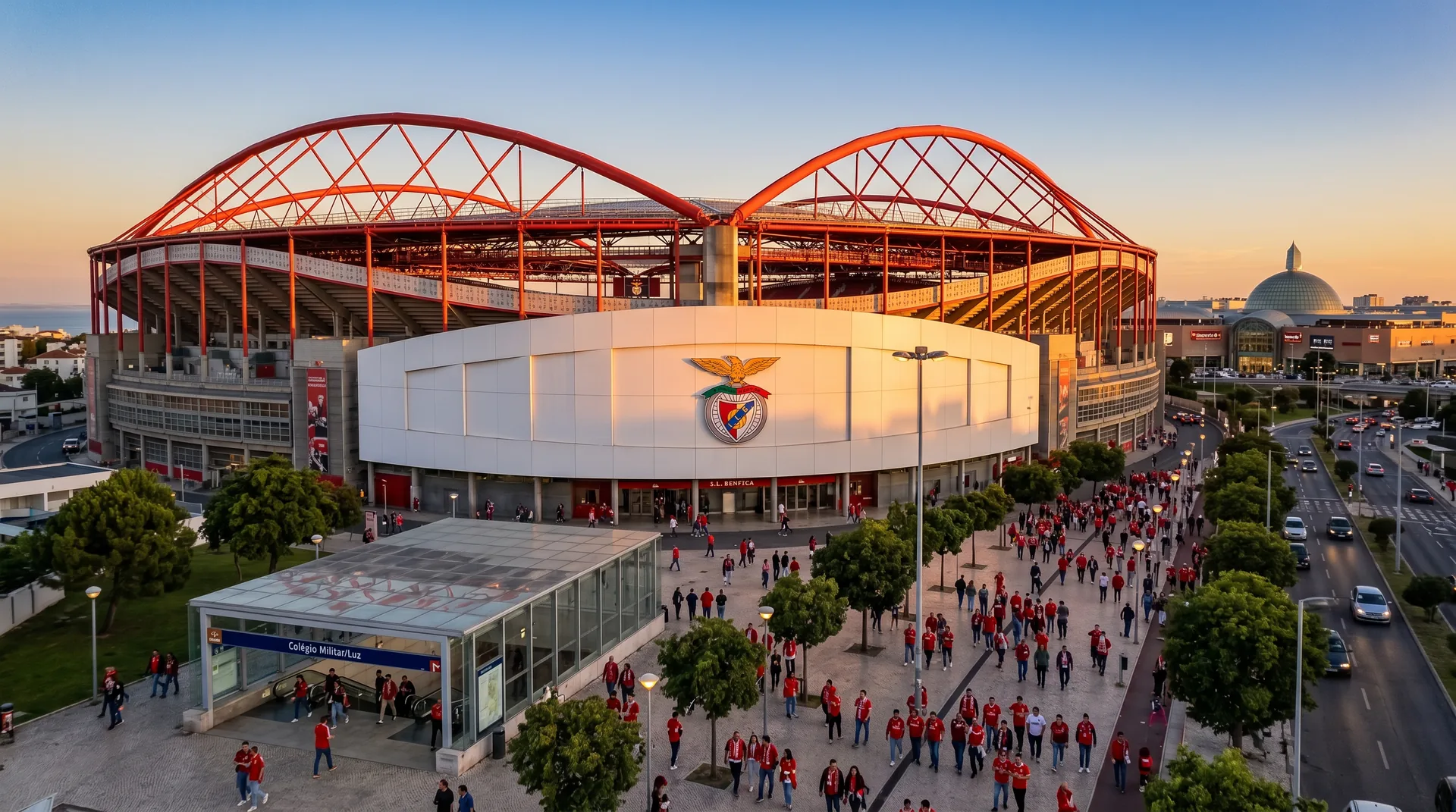
Estadio da Luz capacity
The Estadio da Luz holds 68,100. Benfica president Rui Costa announced on 30 November 2024 an expansion of more than 5,000 seats, taking it to 70,000. A figure of 83,000 circulates widely but came from a losing candidate in the November 2025 Benfica presidential election and is not club policy.Last checked 18 August 2026
📍Benfica parish, Lisbon
⚽Home: SL Benfica
🏗Status: "Benfica District" Masterplan Announced
🏆Europe's Most Beautiful Stadium, 2014
🎭Two Champions League finals hosted
The Benfica District
A €220 Million Reimagining
On 22 July 2025, Benfica unveiled "Benfica District," a sweeping €220 million masterplan designed once again by Populous, this time working with Lisbon-based firm Saraiva + Associados. Rather than simply expanding the stadium, the plan reimagines the entire precinct around it as a year-round sports, culture and entertainment destination, explicitly benchmarked against Wembley Stadium and Manchester City's Etihad Campus.
🎫Capacity Target
70,000+
Up from 68,100, with the architect exploring options up to 80,000
🎾New Arena
10,000 Capacity
Multi-purpose indoor venue for concerts, esports and events
💡Facade
Programmable LED "Skin"
Transforms the stadium into a lit "beacon" for matchdays and events
🏙️Fan Plaza
100m x 40m
Inspired by Lisbon's civic squares, hosting up to 10,000 fans
The masterplan also adds two indoor sports halls (2,500 and 1,500 seats), a community swimming pool, a rooftop football pitch with running track, a 500-seat theatre, and a new fourth level with 6,800 square metres of mixed-use space for offices, hospitality and commercial facilities. The club's iconic Eusébio statue will be relocated to the new main entrance plaza.
What We Don't Know Yet
Reported timelines vary: construction could begin as early as June 2027 with a two-year build, though the club has also described a longer four-year horizon. A separate, more radical proposal for an entirely new 120,000-seat stadium, championed by a former club president, could also resurface depending on the outcome of internal club elections. We'll update this page once the final direction and timeline are confirmed.
History & Significance
Two Champions League Finals, One Euro Final
Estádio da Luz has hosted the Euro 2004 final and three group matches plus a quarter-final, as well as two UEFA Champions League finals: the 2013-14 final, in which Real Madrid beat rivals Atlético Madrid 4-1 after extra time, and the pandemic-relocated 2019-20 final, Bayern Munich's 1-0 win over Paris Saint-Germain. Between 2019 and 2024, the stadium hosted concerts by Ed Sheeran, Rammstein and Taylor Swift.
Estádio da Luz is one of three confirmed Portuguese venues for the 2030 World Cup, alongside Estádio José Alvalade, its Lisbon rival just 3km away, and Estádio do Dragão in Porto.
1954
Original Estádio da Luz opens, eventually reaching a peak capacity of 120,000, the largest in Europe.
25 Oct 2003
Current stadium opens, Benfica beating Uruguay's Nacional 2-1, Nuno Gomes scoring both goals.
2004
Hosts the Euro 2004 final, plus three group matches and a quarter-final.
2014 & 2020
Hosts two UEFA Champions League finals, Real Madrid over Atlético (2014) and Bayern Munich over PSG (2020).
Apr 2024
Confirmed to host a 2030 World Cup semi-final by the Portuguese Football Federation.
Jul 2025
"Benfica District" masterplan unveiled by Populous, in front of FIFA president Gianni Infantino's recorded congratulations.
The stadium is the home of Lisbon's SL Benfica, Portugal's most decorated football club. On 17 February 2026, a Benfica-Real Madrid match set a new stadium attendance record with 66,387 spectators.